Catalog
Search
3936 products
View:
- Selected: 0Areas of use
- Selected: 0Item names
- Selected: 0Manufacturer
- Selected: 0Made in
- Selected: 0Additional
View:
3936 products

Conical flask (Erlenmeyer) made of fluoroplast F-4MB
FIRST FLUOROPLASTIC PLANT
Kirovo-Chepetsk
Produced in: Kirov region, Kirovo-Chepetsk

Washing table LAB-M MO13 80.60.90 SS
Furniture for laboratory work.
Washing table LAB-M MO13 80.60.90 SS
Width, mm: 800
Depth, mm: 600
Height, mm: 900
Equipment:
The table top is a single module made of SUS 201 stainless steel (analogous to AISI 201). Attention! The product is recommended to be used only for work with non-aggressive substances. For work with various reagents, in addition to mineral acids, it is recommended to use washing tables made of AISI 304 stainless steel.
Inner bowl size – 340*400* 130mm
The base of the sink table is a support pedestal made of white melamine
Facades – laminated MDF of white color with a thickness of 16 mm, dark gray ABS edging
Without shelves
LOIP
Saint Petersburg
Produced in: Saint Petersburg
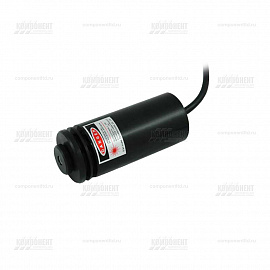
IR laser module KLM-H808-x-5 808nm
from
35 955 ₽
Laser modules of the KLM-H808-x-5 series are optimal sources of coherent radiation for the construction of control and automation systems, alignment and marking devices, for scientific and medical purposes.
FTI-Optronik
Saint Petersburg
Produced in: Saint Petersburg
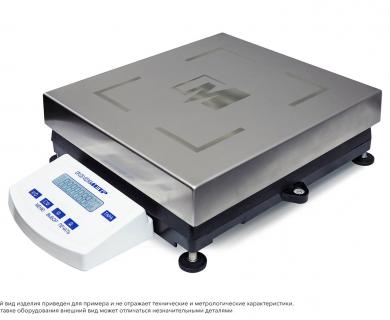
RUNWAY-32 platform scales
from
107 490 ₽
Technical specifications
NIP, kg32
Discreteness, g0.5/(0,2)*
External calibration
The size of the weighing platform, mm350x320 The smallest weighing limit, g50
Accuracy class according to GOST OIML R 76-1-2011II is high
Limits of error allowed during initial verification, goth 50g to 5 kg incl. ±0.5; sv.5kg to 20kg incl. ±1.0; sv.20kg to 32kg incl.± 1.5
Dust and moisture protection (IP)54/65 (on request)
The setting time, s, no more than ~ 1 - 1.5
Weight adjustment 10kgF2*
7 years warranty
Gosmetr
Saint Petersburg
Produced in: Saint Petersburg
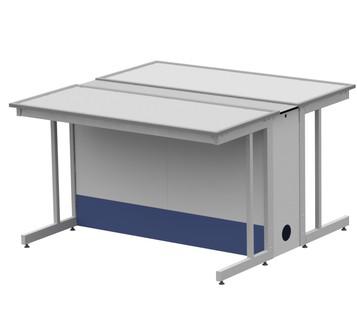
Table island high LAB-PRO SOKv 120.150.90 TR-E16/23
Combined work surface: main table top TRESPA TopLabPlus 16/23mm (with a side made of composite material based on epoxy resins, the height of the side above the table top is 7 mm, depth 30 mm) 650 mm deep / auxiliary table top made of TRESPA material 200 mm deep / main table top TRESPA TopLabPlus 16/23mm 650 mm deep
Length, mm: 1200
Depth, mm: 1500
Height, mm: 900
BASIC EQUIPMENT
The base is a collapsible metal frame made of rectangular steel profile, painted with powder paint (RAL 7035) with the texture of shagreen leather
Four easily removable screens (RAL 7035) and two non-removable (RAL 5023)
Hidden fasteners
Adjustable supports (0-40 mm)
A set of end boxes-plugs
LOIP
Saint Petersburg
Produced in: Saint Petersburg
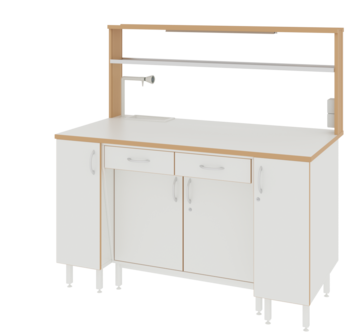
Wall-mounted table LAB-1500 PLTM
equipment
sink-drain (polypropylene, internal size 250*100*150mm), laboratory faucet for water
the scope of delivery includes
a siphon
corrugated
hose flexible liner length 1200mm
rack
support racks – aluminum profile painted with powder paint (RAL 1001)
top panel depth 190mm – metal painted with powder paint (RAL 1001)
LOIP
Saint Petersburg
Produced in: Saint Petersburg
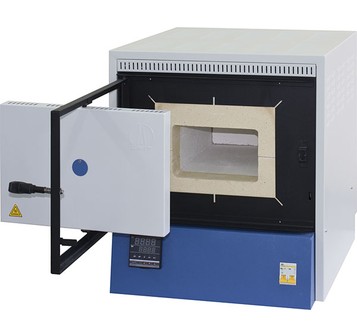
Muffle furnace LF-5/13-G1
Design features:
Durable ceramic muffle;
Semi-open heaters on four sides of the chamber;
Microprocessor temperature controller;
Conveniently located control panel and bright LED display;
Ease of management and control;
LED indicators of heater operation and protection operation;
Automatic shutdown of heating when opening the door;
Alarm when the current temperature exceeds the limits of the permissible range;
Highly efficient thermal insulation of the housing;
The furnace body is made of high-quality sheet steel and painted with heat-resistant powder paint.
Technical specifications:
Maximum heating temperature, °C +1300
Temperature stability in steady-state thermal mode, °C ± 10
Warm-up time to the maximum temperature, no more than 120 min
Dimensions of the working chamber, WxHxD, not less than 200x110x190 mm
Overall dimensions, WxHxD, not more than mm 505x565x565
Rated supply voltage, 220 V
Rated power, W 2800
LOIP
Saint Petersburg
Produced in: Saint Petersburg
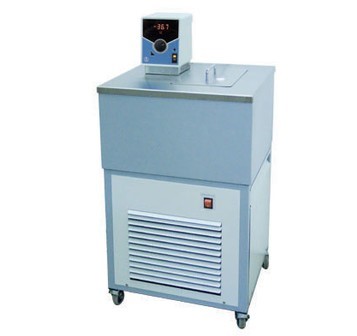
Cryothermostat liquid FT-216-40
Technical specifications:
Operating temperature range, -40 °C...+100
Accuracy of temperature maintenance, °C ± 0.1
The discreteness of the temperature display, ° C 0.1
Cooling capacity at 20°C,
Tue 770
Pump capacity in the discharge (suction) circuit, not less than, l/min 10.5
Volume of working fluid, l 16
Open part of the bath/depth, mm 248x170/200
Power supply, V/Hz 220/50
Power consumption, not more than 3.6 kW
Overall dimensions, mm 450x420x890
Weight without working fluid, kg 60
LOIP
Saint Petersburg
Produced in: Saint Petersburg
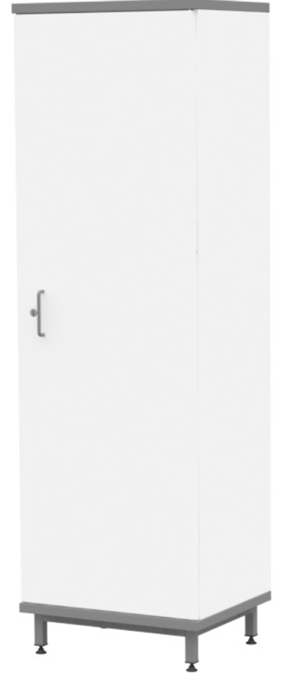
Reagent storage cabinet LAB-M SMR 60.50.194
Furniture for laboratory work.
Reagent storage cabinet
Length, mm: 600
Depth, mm: 500
Height, mm: 1940
PACKAGE
CONTENTS housing – metal painted with white powder paint (RAL 9016)
roof, bottom, shelves - metal painted with dark gray powder paint (RAL 7011)
facade – metal painted with white powder paint (RAL 9016).
LOIP
Saint Petersburg
Produced in: Saint Petersburg
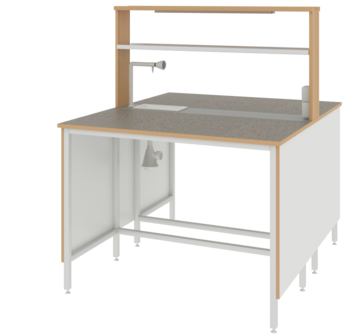
Island LAB table-1200 OKM
equipment
sink-drain (polypropylene, internal size 250*100*150mm), laboratory faucet for water
the scope of delivery includes
a siphon
corrugated
hose flexible liner length 1200mm
rack
support racks – aluminum profile painted with powder paint (RAL 1001)
top panel depth 190mm – metal painted with powder paint (RAL 1001)
LOIP
Saint Petersburg
Produced in: Saint Petersburg
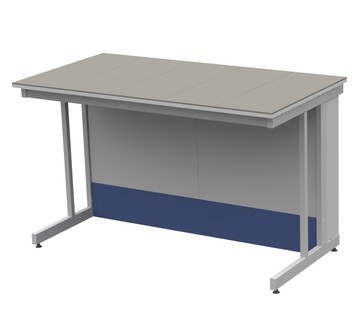
Wall-mounted low table LAB-PRO SPCn 180.80.75 KG
BASIC EQUIPMENT
The base is a collapsible frame made of rectangular steel profile, painted with powder paint (RAL 7035) with the texture of shagreen leather
Hidden fasteners
Two easily removable rear screens (RAL 7035) and one non-removable (RAL 5023)
Rear side boxes
Adjustable supports (0-40 mm)
LOIP
Saint Petersburg
Produced in: Saint Petersburg
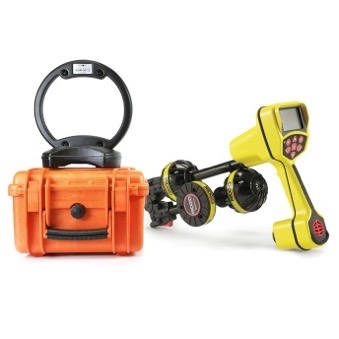
Cable searcher Athlete AG-320
The Athlete AG-320 cable searcher is a combination of the modern American Ridgid SR-20 track finder receiver and the most powerful multi-frequency portable generator AG-120T in the line of TECHNO-AC generators.
Features of the SR-20 receiver
• – Can track any frequency from 10 Hz to 35000 Hz;
• – 8 multi-directional antennas allows you to display a schematic representation of the desired communication in the form of a straight line;
• – The information necessary for the search of communications (operating frequency, signal strength, signal intensity, depth of occurrence, etc.) is displayed automatically.
TEKHNO-AS
Kolomna
Produced in: Kolomna, Moscow region